
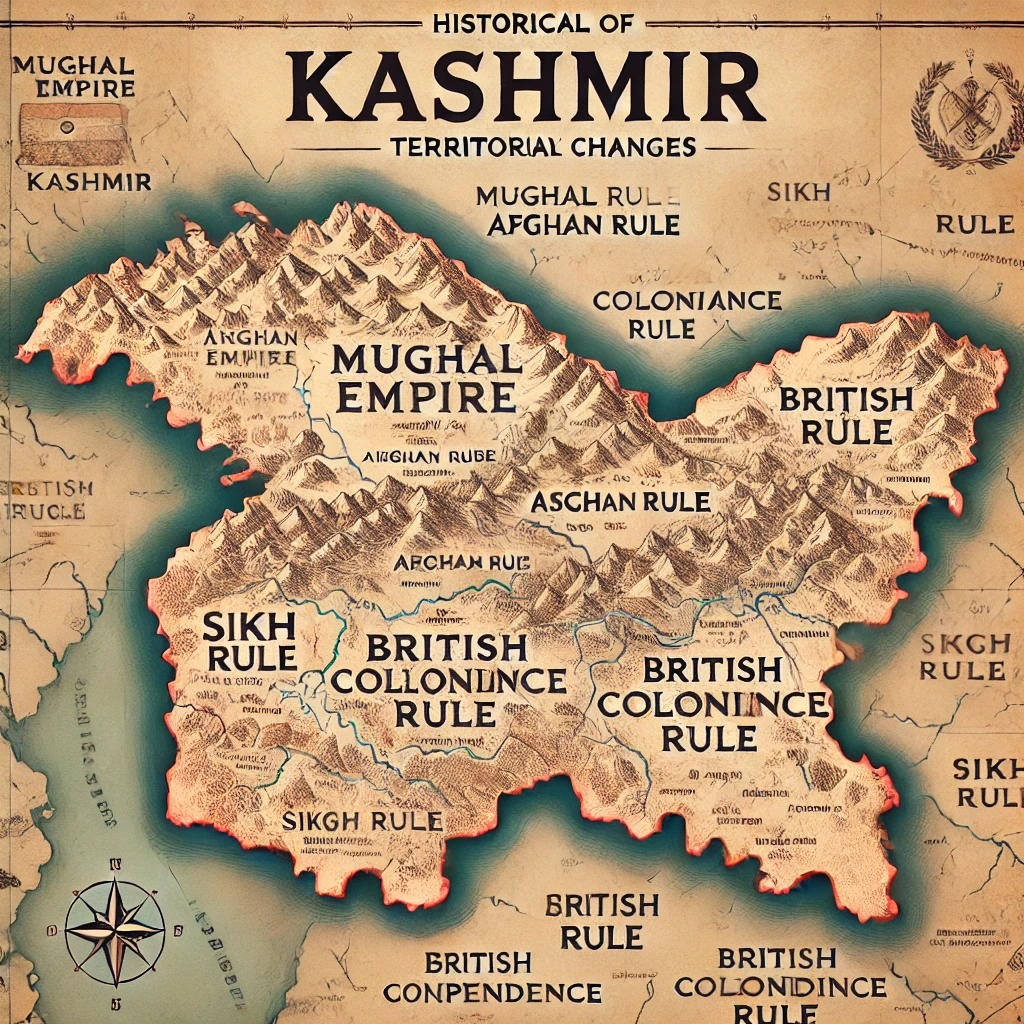
Nestled in the Himalayas, Kashmir’s breathtaking beauty has always been matched by its turbulent history. For over 5,000 years, this “Paradise on Earth” has been a crossroads of cultures, faiths, and empires—shaping the complex region we know today.
-
Ancient & Medieval Kashmir
Hindu and Buddhist Beginnings
Kashmir’s early history was shaped by Hindu and Buddhist influences. The Mauryan emperor Ashoka introduced Buddhism in the 3rd century BCE and founded the city of Srinagar. Later, the Kushan emperor Kanishka made Kashmir a major centre for Buddhist learning, hosting the important Fourth Buddhist Council.
The region’s golden age arrived with the Hindu Karkota and Utpala dynasties (7th-10th centuries CE). They unified the valley, built magnificent temples—such as the now-ruined but once-splendid Martand Sun Temple—and fostered great art and literature. It was during this time that the poet Kalhana produced his famous historical chronicle, the Rajatarangini (River of Kings), which remains a vital source for understanding Kashmir’s past.
The Coming of Islam
Islam arrived in Kashmir not by the sword, but peacefully through Sufi saints and missionaries from Central Asia and Persia. This period culminated in the establishment of the Shah Mir Dynasty in 1339, which marked the beginning of Muslim rule. The dynasty’s greatest ruler, Sultan Zain-ul-Abidin (1420-1470), known as the Budshah (Great King), stands out as a remarkably tolerant and secular ruler. He actively promoted a blend of Kashmir’s diverse traditions, suspending taxes on non-Muslims and encouraging arts and learning. This era also saw the rise of the syncretic Rishi movement, which beautifully merged Sufi Islamic mysticism with local Hindu yogic and Buddhist practices.
Mughals and Afghans
The Mughal Emperor Akbar conquered Kashmir in 1586, incorporating it into the vast Mughal Empire. The Mughals fell in love with the valley’s beauty, building the famous terraced Mughal Gardens—like Shalimar Bagh and Nishat Bagh—along the shores of Dal Lake, transforming the landscape. However, after the decline of the Mughal Empire, Kashmir fell to the Durrani Empire of Afghanistan in 1752. This period was a dark age for Kashmiris, marked by brutal governance, heavy taxation, and persecution, leaving a deep scar on the region’s collective memory.
-
Colonial Era & The Conflict Begins
The Treaty of Amritsar (1846)
The British, after defeating the Sikh Empire in the First Anglo-Sikh War, found themselves in control of the Kashmir Valley. Unwilling to govern it directly, they executed the Treaty of Amritsar, selling Kashmir for a paltry sum to Gulab Singh, the Hindu Dogra ruler of the principality of Jammu. This created the new princely state of Jammu and Kashmir—an artificial entity ruled by a Hindu Dogra dynasty over a predominantly Muslim population. A century of unequal treatment and feudal oppression under Dogra rule sowed deep divisions between the rulers and the ruled.
1947: Partition and Accession
As British India was partitioned into India and Pakistan, the princely states were given a choice: accede to either dominion. The Maharaja of Kashmir, Hari Singh, a Hindu, hesitated, hoping to remain independent. His hand was forced in October 1947, when Pashtun tribesmen, backed by Pakistan, invaded the valley, aiming to seize Srinagar. Facing a desperate military situation, Hari Singh appealed to India for help. India agreed to send troops on the condition of accession. On October 26, 1947, the Maharaja signed the Instrument of Accession to India. Indian troops were airlifted to Srinagar the next day, saving the city from the invaders. The first war between India and Pakistan over Kashmir had begun.
-
Wars Between India and Pakistan
- 1947-48 War: The first war ended with a UN-mediated ceasefire, effectively partitioning the region. India held the Kashmir Valley, Jammu, and Ladakh, while Pakistan controlled a sliver in the west (Azad Kashmir) and the northern territories (Gilgit-Baltistan). The UN resolution called for a plebiscite to determine the people’s will—a vote that has never been held.
- 1965 War: Pakistan launched Operation Gibraltar, aiming to infiltrate forces into Indian-administered Kashmir to spark an uprising. The plan failed, and the ensuing full-scale war ended in a stalemate.
- 1971 War & Simla Agreement: Following the war that led to the creation of Bangladesh, India and Pakistan signed the Simla Agreement. They converted the old ceasefire line into the Line of Control (LoC) and committed to resolving the dispute peacefully through bilateral negotiations.
- Siachen Conflict (1984): In a race to claim the uninhabited heights of the Siachen Glacier, India launched Operation Meghdoot and occupied the strategic passes. This led to an ongoing conflict at the world’s highest battlefield, where extreme weather conditions often cause more casualties than enemy fire.
- Kargil War (1999): In a daring and risky move, Pakistani forces and militants crossed the LoC and occupied high peaks in the Kargil district of Indian-administered Kashmir. India launched a fierce military campaign, Operation Vijay, to recapture the peaks. The conflict brought the two nuclear-armed nations to the brink of a major war and ended only after international diplomatic pressure forced Pakistan to withdraw.
-
The Continuing Story
Today, Kashmir remains one of the most militarised regions in the world. It is divided and disputed—claimed in full by both India and Pakistan, but administered in parts by each. The people of Kashmir, particularly in the India-administered valley, have lived through decades of armed insurgency, counter-insurgency operations, and political unrest. The beautiful land of ancient Buddhist monasteries, splendid Mughal gardens, and rich syncretic culture is now also a land of conflict and tragedy.