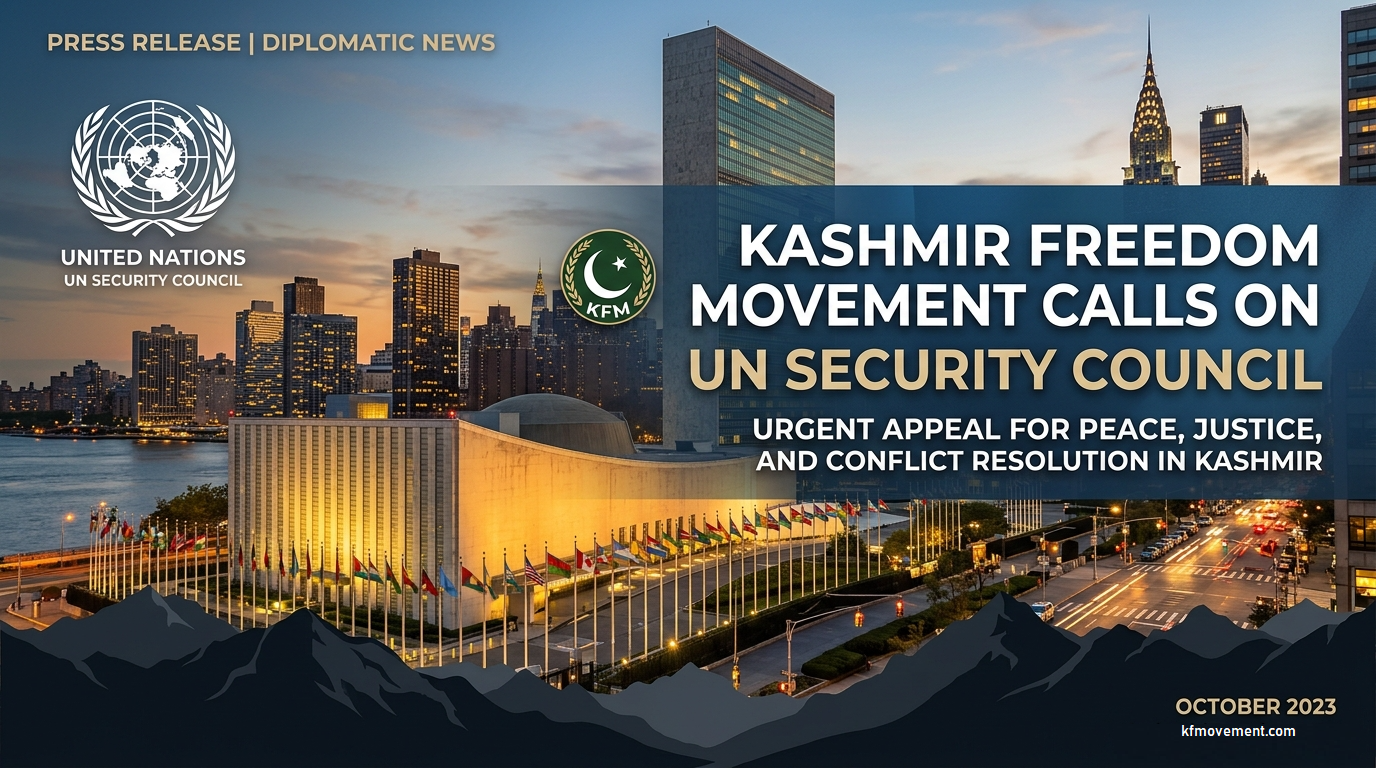
New York, NY — The Kashmir Freedom Movement (KFM) has formally called on the President of the United Nations Security Council (UNSC), H.E. Ambassador Asim Iftikhar Ahmad of Pakistan, to use the opportunity of Pakistan’s July 2025 Council presidency to champion a comprehensive and multilateral approach to resolving the long-standing conflict in Jammu & Kashmir.
In a letter addressed to the Council President and copied to all permanent and non-permanent members of the UNSC, KFM Foreign Affairs Board, Chairperson, Ghulam Hussain urged the Council to move beyond decades of bilateral deadlock and recommit to implementing its own resolutions—particularly Resolutions [47 (1948)] and [80 (1950)]—which call for a UN-supervised plebiscite and military de-escalation in the region.
“The absence of sustained, impartial implementation has left the region mired in militarisation, recurring cycles of violence, and egregious [human rights abuses](w),” said Hussain. “We believe that the Security Council’s renewed attention this month can break the impasse by embracing a multilateral conflict‑transformation model.”
The KFM has proposed a four-pronged strategy for immediate consideration under the Council’s “Any Other Business” agenda:
- Referral to the International Court of Justice (ICJ) under [Article 96 of the UN Charter](w) for an advisory opinion addressing plebiscite modalities, demilitarisation benchmarks, transitional justice, and interim governance pathways.
- Transformation of the UN Commission for India and Pakistan (UNCIP) into a permanent Jammu & Kashmir Peace Transformation Commission—tasked with overseeing phased troop withdrawals, initiating reconciliation workshops, and facilitating local participation through citizens’ juries.
- Deployment of UN Special Procedures within a Peace & Rights Barometer, co-developed with Kashmiri civil society, to produce quarterly reports on human rights, humanitarian needs, and freedoms of assembly and expression.
- Creation of a “Jammu & Kashmir Transformation Forum”, an informal coalition of cross-regional UN Member States to sponsor thematic working groups focused on governance, economic renewal, climate resilience, youth engagement, and psychosocial healing.
“This multidimensional framework honours both the letter and spirit of the Council’s historic commitments while putting Kashmiri voices at the centre of a sustained UN peace process,” said Hussain. “It is time to replace inertia with action, and symbolism with substance.”
The KFM stands ready to support the Council through expert briefings, logistical coordination, and grassroots testimony. “We urge the Security Council to act decisively under Pakistan’s leadership this month,” concluded Hussain, “so that the people of Jammu & Kashmir may finally realise their right to peace, dignity, and self-determination.”